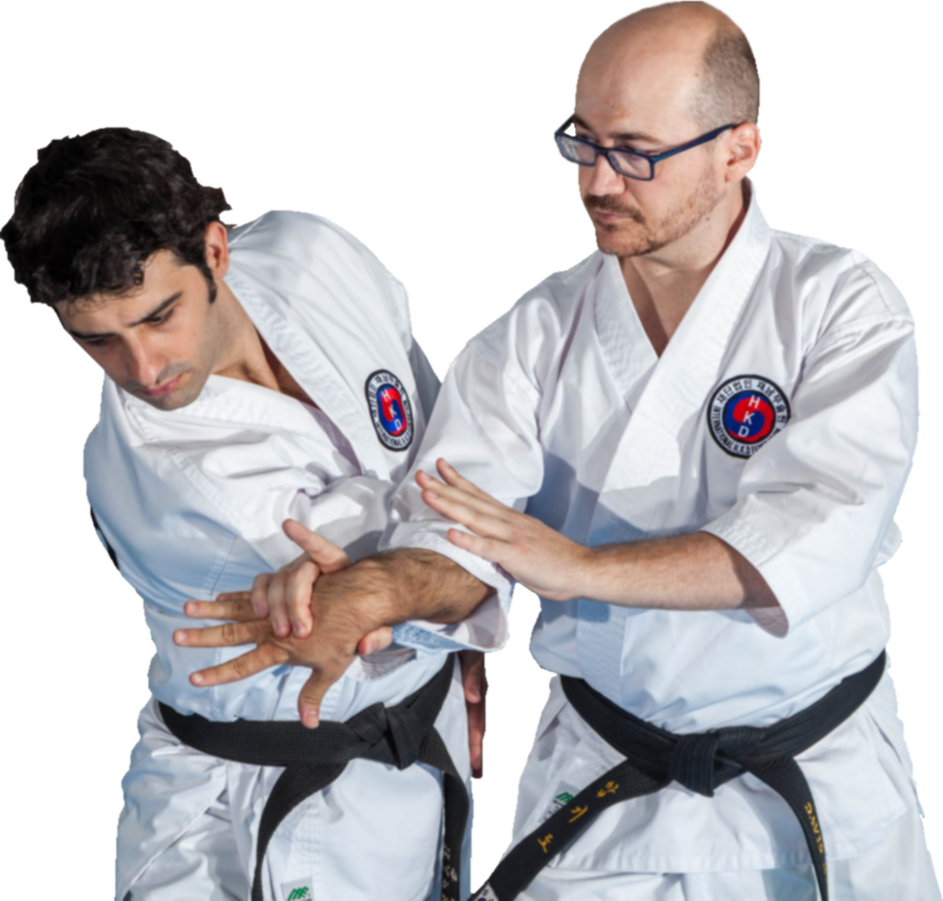
Hapkido is a dynamic and very complete Korean Martial Art...
This martial art can be described as a hybrid art, both physical and energetic, where brute force is not a primary requirement and where the movement of one's own body (kinetic chains), breathing and reaction speed when performing different techniques are important.
It is also an internal or soft system, although its training is very vigorous and demanding. With hapkido, the energetic development of the individual and their formation as a person is also sought.
When speaking of Hapkido, people usually talk about two tendencies: one hard and linear, and another more circular and fluid. Its founder, Master Choi Young Sool, was born in 1904 and died in 1986.
The Hapkido promoted by the IHF HKD is direct, but also circular and fluid. We do not move away at all from hard and linear techniques, but we focus heavily on circular work which we think offers greater development of technique, as well as of the person.
Hapkido is a heterogeneous and hybrid discipline, since it is composed, in its origins, of various fighting methods. For this reason, some Masters focus the art towards some of its particular techniques, while others do so towards others. From a technical-tactical point of view, it is observed that this martial art has a clear influence from Japanese daitō-ryū aiki-jūjutsu (also the father of aikido), Judo and kung-fu (or wushu) originating from China, in its chin-na section (joint locks, holds, grips). On the other hand, the influence of sam rang do tek gi is observed in the ki energy projection techniques and Taoist meditation, as well as the Korean art of taekkyon in the various kicking techniques.